Hoofprints for Wounded Hearts
- Jul 7
- 6 min read
FIELD UPDATE
We have a very precious group of young children. Those who find school hard. Those who just don't fit in. Those who struggle with learning and lag behind. Those who are losing hope at the beginning of their educational journey. Those who need a quiet space, a gentle word, a hug when they struggle, and the sound of hands clapping when they break through.

They are not special needs; they just need a little more attention than others, and a little more encouragement. They need the pace to slow down. They need to be seen. They need to be heard.
They are all tent kiddies, those born since the genocide. Those born into genocide. Those born into noise, into a lack of privacy, into lack of attention. Those born into survival mode. Those born into lack. Lack of everything. Those who don't miss anything because they don’t know that there is anything to miss.
Shex Khalid is the perfect educator and mentor for them. As a loving father, he pours a very fatherly love into these little ones who come alive as they learn. His lessons are very hands-on, always practical, always with examples from life.

They heard about this magical place, “the stables,” and wanted to visit. He prepared them by showing them photos of our herd, teaching them their names, and encouraging them to colour pictures of them. As they learned their names, excitement was mounting. Then the big day came.
Today we share snippets of their journey where hoofprints redefine their hurting hearts.





Eliyada is seven years old and was so excited to visit real-life horses with her new friends from the Hope Centre, Janan, Vida, and Chiman. When she returned home, she shared all the details of her adventure with her mother. She remembered the names of all the horses, Sultan the peacock, and Oscar, our dog, who was the first to welcome the children.
She loved the bus ride. She had never been outside the refugee camp or on a bus, so everything was new for her. She delighted in the tranquility, in the birdsong, in the abundance of green (our barley and extensive flora). The only colours with which she was familiar were the dirty white of the tents and the beige sand that gets into everything. At the stables, nature shows off its glory with a riot of colour.




Because she had learned about the horses, she anticipated that they had learned about her and prepared themselves for her, so she was ready to get close to them and be embraced by their kindness and gentleness.
Her mother told us that upon her return she expressed her joy. She spoke about the noise of the camp, which causes her anxiety, and the calm of the stables, which she termed “my better world, my place of joy.”

On the day of the visit to the stables, Vida, a first-grade student in the camp school, woke up early, chose special clothes, and dressed as if she were going to a celebration. She was the first of all her friends to arrive at the Hope Centre and waited eagerly for the bus to come. She chatted nonstop about what she expected to see, and how she expected the horses to be.
Vida shares that the strength of the horses gave her great peace, that it was an amazing experience to stand alongside such a huge animal and to feed it fresh barley. She too noticed how everything was bursting with life: the trees with the summer fruit breaking through, fruit that she could not identify as she had never eaten figs or apricots or picked mulberries from the trees.
As young as she is, Vida discovered that an entire world awaits her outside the camp, and that succeeding in school is one way to be part of that world, a world far away from the hardships and suffering of the camp. She is already waiting to return to the stables and experience the joy of sitting on the back of a horse.
She wishes to thank everyone who made this day so very special, one she will never forget.


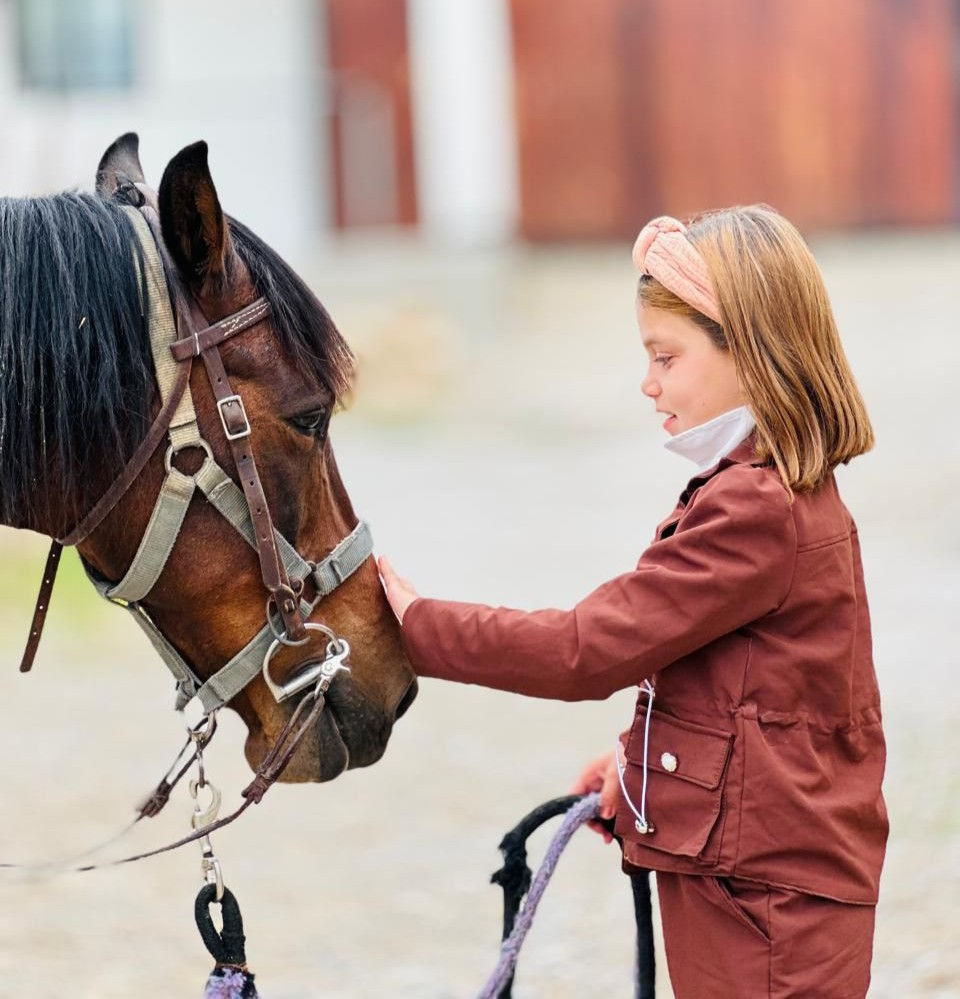
Banaf, age 7, took on the role of family ambassador, commissioned by her father to visit the stables and represent them. Her father is a municipal worker, employed as a cleaner, whose dream it is to visit the stables, a place he has heard of as he works in the camp, a place where he is told that miracles take place. He was so overjoyed that his daughter would go and told her to take in every detail and share with them.
On the day of the visit, Banaf woke up early, full of happiness. She prepared herself with excitement, knowing that not only she but her whole family was happy about this opportunity. Her family was waiting eagerly for her to return and tell them about her experience.
When they arrived at the stable, Banaf felt amazed. The place was large and beautiful, filled with trees, flowers, and animals. It was her first time being in such an environment. In the camp, she is used to seeing only roads and dust, with very little greenery. The stable felt like a completely different world.
The teacher guided the children around the stable, explaining everything to them. They had the chance to take pictures with the horses. Banaf was especially happy to see them up close for the first time. The horses were big, beautiful, and gentle. She even remembered their names and felt a special connection with them. One horse in particular, Nawroz, stood out to her as especially kind and loving.

Being close to the horses, touching them, and interacting with them gave Banaf a feeling of joy and peace that she had never experienced before in the camp. It gave her the sense of accomplishment, of achievement, and success that she had never before experienced, an empowerment that will pour over into her school life.
When she returned home, her parents were waiting eagerly for her. She shared everything about her day: the horses, the stable, and the activities they did. Her parents listened with great interest, and they expressed a wish to visit the stable one day themselves and experience it firsthand. Her father’s heart literally swelled with pride that his daughter had been the first in his family to visit.


Dear Friends, it is our joy to share these beautiful animals that we have been given to live alongside and to learn from, with kiddies such as these, with our special needs groups who have so bonded and found friendship within their group, with autistic children, with students who were rescued from ISIS, and with fathers and mothers whose hearts swell as their children achieve that which they can only dream about.

Everyone who comes is impacted. Everyone who visits is changed. There is no such thing as a mere visit to the stables. It is not something to be taken lightly. It is not a pastime or a hobby. It is an experience of presence, of being, and of gentle healing. It is the engagement of hearts, of balm for the soul. It is weighty. It is often silent. A place where human instruction is superfluous.
Nearly every week I receive messages from parents in Duhok who are willing to pay for riding lessons for their children. I have to admit that when we struggle for money to feed our horses, such messages are a temptation, but our commitment remains strong to the ministry of healing fragmented lives.
To the service of enabling young kiddies such as these to find a joy they did not know existed, to discover a world where they succeed, where they are the head and not the tail, and to see this be translated into their tent world and education in the very bleak camp schools.

And yes, as you read this, their parents will be discovering their own personal hoofprints at Horses for Hope that will add depth and breadth to their interaction and support of their children.
Our journey at Horses for Hope is one of horses, a couple of peacocks, ducks, chickens, geese, rabbits, and, of course, Oscar. It is a journey of so much love, respect, dignity, and patience. It is a journey when man fades into the background and the horse leads the way.
It is a journey of quiet and gentle legacy, of being present enough, honest enough, transparent enough, and willing enough to enable these sensitive animals to leave their hoofprints on wounded hearts, leading them gently into a place of healing, and a future, one that lies beyond the dusty tents of an aging refugee camp.


We cannot leave hoofprints behind us without your financial help. In this season of war, we are more than struggling. We would value your help to enable us to continue this precious work amongst the most vulnerable.
Thank you.



Comments