Legacy for the Next Generation
FIELD UPDATE

My plan was to write about our participation in the annual village festival, which is an event we look forward to each year, and maybe next week I will. I was on a Zoom call yesterday where the host briefly recounted some twenty years of his organisation’s history.
That got me thinking about our twelve-year journey here in Mesopotamia. A book could be made of the stories that have been told and those that sit deep in our hearts that we have not shared.
The commandment found in Exodus 13 says (and the annual Passover Haggadah builds on this), “And you shall tell your child on that day, saying it is because of what the Lord did for me when I came out of Egypt.” It’s about legacy, each of the following generations personally identifying with a living tradition of faith as history.
Our students have indeed come out of their Egypt. Because of this, our journey has been one of pioneering, clearing the way for others who will come behind us. It's been a journey of “many dangers, toils and snares,” as in many, many stories and events that we cannot tell. But we have been blessed and graced with much laughter along the way.
As our journey continues and in August will enter its 13th year, I recall our day of very humble beginnings.
Sometimes we rushed into the places that angels feared to tread. We held a fashion show in the camp marquee. Twenty girls who had newly been released from captivity were garmented in the most exquisite gowns, each tailor-made by a Hollywood designer. The background was a simple table covered in the black garments of captivity. Gold, silver and copper of freedom and value set against garments of slavery.
We had carefully written “reserved” on probably five front rows, planning them for women. However, all the usual male suspects rushed in, sweat pouring down their faces in the heat, and set themselves down in the reserved rows. As they were dignitaries, we had no recourse but to dignify them and accept it. But in that moment we realised that our beautiful fashion show giving the girls worth and value had high potential to go south and resemble the “slave markets” of Raqua, where “buyers” came to eye the girls and bargain for them.
Thank God all was wonderfully redeemed and Springs of Hope Foundation was officially launched.

It was there that I met Saad. We met Saad. Every organisation needs a Saad. He came to me after the event bursting with enthusiasm and ideas. Trying to respectfully brush him off, I gave him my WhatsApp number and requested that he send his comments on that platform.
Thus began life with Saad. Scrolls and scrolls of comments every day until he wore me down. We met, we hired him. He immediately asked for a title and a certificate of authentication. The title that he chose was Operations Manager and operate he did until his operations took on a nocturnal shift using our vehicle and we had to release him.

There was a period in time when Musa made a close connection with a Swedish Kurdish organisation, another interesting story of two brothers who had escaped the Halabja chemical bombing and escaped across the border into Iran and from there eventually to Sweden, where they established successful businesses. In their success, they remembered their roots and shipped containers of “out-of-season” goods and clothes into Kurdistan.
We received many top-of-the-line clothes from them, one shipment was Hunter rain boots. Perfect, so we thought, for the mud surrounding the tents located in the village, and the fields around.
We waited for a cold, wet night and headed out in confidence to give away the Hunter boots, taking care to have a couple of chairs to sit on whilst trying out sizes, and a massive tarpaulin to lay on the ground above the mud.
Our confidence was quickly demolished after the head of a tribe came charging out of his tent, throwing all the boots his family had taken back at us. He pulled out his rifle and began shooting into the air, calling all his tribe to war over the offence we had caused. (I still haven't figured this one out.) Dr Saeed instructed Saad to take me home, but neither of us would go and miss the action. This was one time when Saad and I stood in strong agreement.
What this boiled down to was a standoff between this man’s tribe and Dr Saeed’s tribe, meaning the entire Shariya village. The village won and the man retreated to his tent minus twenty pairs of Hunter boots. We were more careful after that.

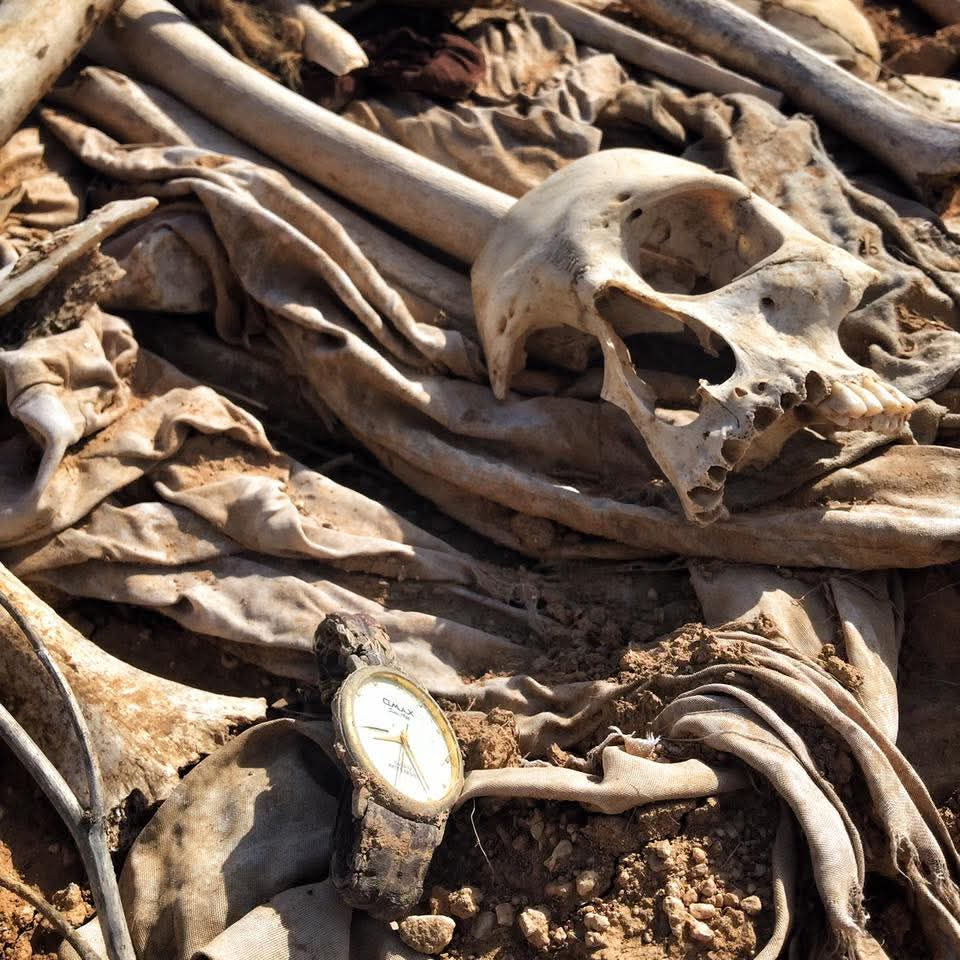
We have driven hours and crossed checkpoints and borders to visit the mass graves of Sinjar, where we walked in silence for hours unable to take in the horrors, but knowing that in order to work and to be in the lives of these precious people, we needed to see, we needed to be wrecked and totally disturbed by the horrors that they had endured.
I remember driving through destroyed village after destroyed village, not being able to even step outside our vehicle due to the possibility of unexploded land mines. Villages where all our students were raised in tranquility and peace. So when one would say, “I came from Dugre,” we could show photos of us drinking chai with the only store owner there trying to sell a few rotten vegetables in a bombed-out kiosk. Our students knew that we understood, that we were an organisation with a heart and no agenda.

Our first visit to Sinjar was with the wonderful Shex Shamo (of blessed memory), who invited us to visit with the first Parliamentary Protocol from Erbil after the release of Sinjar from ISIS. I was the only woman in this protocol and was treated like royalty. At one point we visited a Peshmerga base overlooking a camp still occupied by ISIS. The Shex handed me his pistol and gave me the honour of shooting the first shot over the desert towards their camp. He gave me the instruction, “Shoot, madam, in the name of your country.” I, of course, obeyed.

We have had highs and lows. We have come home at the end of the day and gathered around my yellow kitchen table, cried, wept and screamed at the evil of this day. Then pulled ourselves together to be strong and of sound mind for the next day.

As men, women, teens and children were being released from captivity, they found their way to us. Some were actually released in order to come to us, and from our campus spread the octopus tentacles to recruit a new generation from inside Kurdistan. From being a place of refuge for those who had escaped, or been ransomed from ISIS, we became its target. We became its mission. To destroy us so that we could not help the broken. To use our campus to set up the throne of the caliphate in the region. As if.
We had heard about the enemy, we had seen how he had ravaged an entire region, the villages of Sinjar, how he had destroyed an entire community in its generations, how it had eradicated the culture and then it appeared on our property face to face. The caliphate had trained a few broken Yezidi women to be its ambassadors, its new face in Kurdistan.
We were up against a new enemy, the one from within. It was a hard period of time, one where many visits were made to uncles and aunts with the sad news of their ward’s activities. We were not fighting for our existence as an NGO, but fighting for the freedom and healing of our students, and fighting for the girls who had been brainwashed.
We won many battles because we were a core team united in purpose. We lost some battles as some orphan students were in over their heads and were a danger to us all. We had to let them go.
We have seen tragic suicides, we have wept, we have mourned and we have danced at weddings of those whose bodies and souls were torn apart as a flimsy, dirty garment.
We have walked in the valley of the shadow of death and realised that as dark as it is, it is only a shadow. We will not fear. We have laid down in periods of rest in green pastures. We have carried both swords and shepherds’ crooks with us at all times.
If we would sit together we would have so many stories. Stories of lives redeemed, of situations turned around, of the daily miracles. Of the changing seasons. Of the goodness of God in the land of the living. Of His goodness and mercy which have radically pursued and overtaken us. Of His providing the answer when totally stuck and out of our depth. Stories that are testimonies for the generations that will come after us.
These, dear friends, have been twelve hard years, twelve good years, twelve frustrating years, twelve joyful years. We are telling the story of Hope to yet another generation now. We are writing legacy for them, and God willing they too will tell the story of redemption.
Our kids in Australia still talk about Springs of Hope when they meet, they recall our triumphs, our victories. They recall the days when the guys would only sit in military formation, with their military units (as in captivity) when they ate, and now they are marrying and starting their own families. They visit the graves of the dead but go home to a pregnant wife.
Legacy. Who would have believed that Legacy would be written on the plains of Mesopotamia, on the other side of the mountain where Nachum the Prophet is buried.
Friends, we have so many stories. Lives restored. Hearts healed. Twelve years with more to go. Thank you for being our journey partners. Thank you for believing in and supporting our mission.
Thank you for being our rear guard and for supporting us. Maybe one day we will all gather around my yellow table and rejoice over the legacy of the plains. Maybe you too will tell our story to your generations so that they will have something of a road map should evil raise its head in their region. Legacy prepares.
God bless you all.


Comments